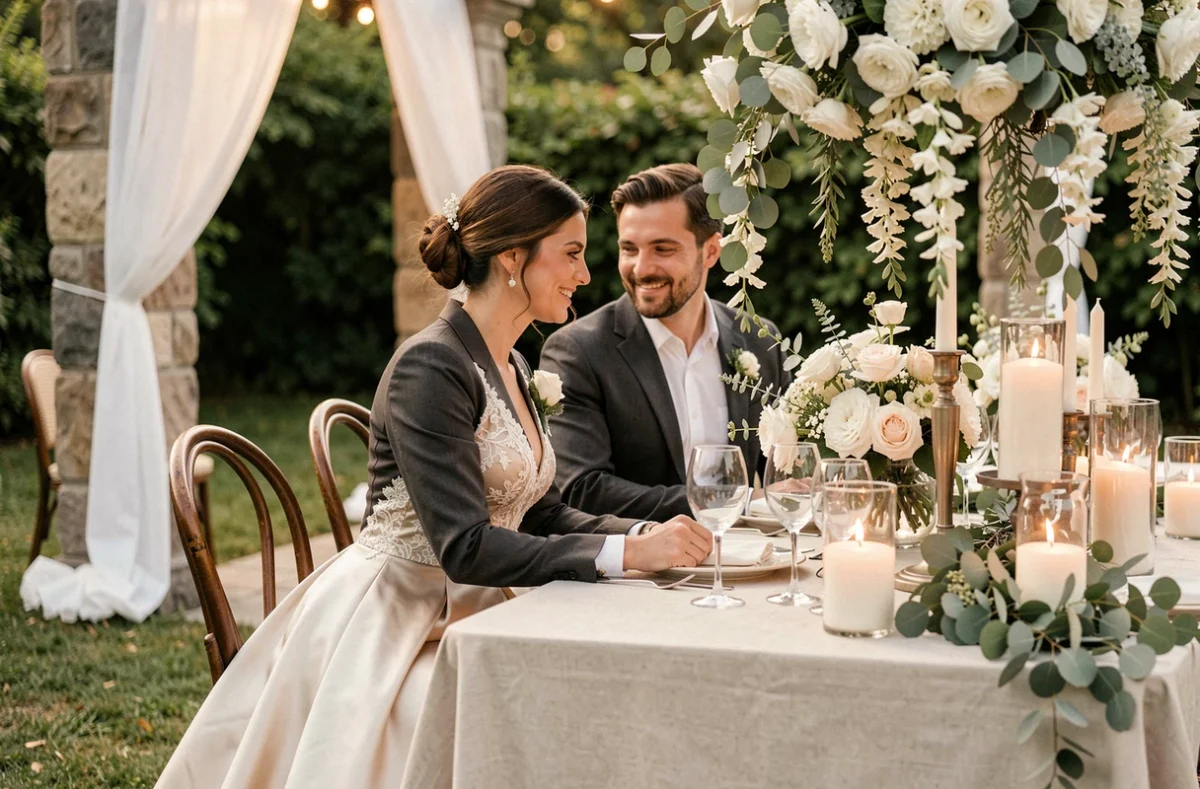
Organizing an elegant wedding means making decisions on budget items whose relative weight varies greatly depending on the chosen format. Venue, catering, decoration, number of guests: each choice alters the overall balance and, by extension, the atmosphere of the day. Comparing these items helps identify where to concentrate financial efforts to achieve a result worthy of the occasion.
Wedding budget in France: distribution of key items according to format
The total budget of a wedding depends on the number of guests, the venue, and the level of service. The gaps widen as one moves from an intimate format to a classic reception of more than a hundred guests.
| Item | Estimated budget share | Main variable |
|---|---|---|
| Venue | About 30% | Season, region, prestige |
| Catering and drinks | About 25-30% | Number of guests, type of menu |
| Decoration and flowers | About 10-15% | Scenography, floral species |
| Photography and video | About 8-10% | Coverage duration, deliverables |
| Attire of the couple | About 8-10% | Designer, alterations, accessories |
| Entertainment and music | About 5-8% | DJ, band, sound system |
The venue and catering alone absorb more than half of the budget. Couples seeking a refined ceremony often direct this ratio towards the venue, even if it means reducing the number of guests.
Specialized resources like Les Secrets de la Mariée detail these decisions by service category, helping to structure priorities from the early months of preparation.
Intimate wedding or large reception: what the numbers reveal
The average age at marriage in France is now around 37.5 years for women and nearly 40 years for men in heterosexual unions. This greater maturity transforms expectations: couples prioritize the experience of each guest over the volume of the reception.
In practice, an intimate wedding (fewer than fifty guests) allows for reallocating the catering budget towards the venue or decoration. The cost per guest increases, but the total amount decreases.
Two-day format, a new budget variable
More than half of couples now desire a two-day format with a brunch the following day. This second highlight adds an additional item (venue, Sunday morning catering), but it also transforms the overall atmosphere of the wedding by extending the reunions.
Budget-wise, the brunch represents a moderate additional cost compared to the reception dinner, provided one chooses a venue that allows on-site accommodation. Historical properties and country houses, increasingly sought after by couples aged 18 to 34, often offer this possibility.
Elegant wedding decoration: the choices that change the atmosphere
Decoration absorbs between 10 and 15% of the budget, but its visual impact is disproportionate. Two approaches are clearly opposed.
- Voluminous floral scenography (arches, tall centerpieces, hanging garlands) mobilizes the majority of the decoration budget on a single provider, the florist.
- Decoration through the accumulation of non-floral elements (candles, fabrics, vintage objects, lighting) spreads the budget across several suppliers and allows for more flexibility.
- The mixed approach combines a few strong floral pieces (ceremony altar, one centerpiece out of three) with elements of light scenography, often more cost-effective for large spaces.
The choice of floral species weighs as much as the volume. Seasonal flowers cost significantly less than imported varieties, and their freshness holds up better over an entire day.
Personalization versus standardized theme
Specialized media note that by 2026, couples are less inclined to follow a fixed theme and more focused on creating a celebration coherent with their story. The pre-formatted “rustic” or “bohemian” gives way to color palettes and visual codes built from personal references (travels, shared passions, significant places).
This shift has a concrete impact on the budget: personalization requires more design time (in advance with a decorator or wedding planner) but not necessarily more money. It does, however, require starting the decorative reflection early, at least eight to ten months before the date.
Catering and reception menu: the item where negotiation matters most
Catering represents the most sensitive item because it combines a unit cost per guest and a direct effect on guest satisfaction. Three levers allow for optimizing this item without sacrificing quality.
- The choice of service format: a seated dinner with a single menu is cheaper in logistics than a meal with multiple options, while giving a more polished impression.
- The seasonality of the menu: a caterer who works with seasonal products reduces their procurement costs, which reflects in the quote.
- The volume of drinks: the drinks item can represent a third of the catering quote. Negotiating a per-person package rather than an open consumption limits overruns.
Requesting several detailed quotes (not just a global price per guest) allows for comparison line by line and identifying items where savings are possible without affecting the experience.
Preparation timeline: the deadlines that condition the result
An elegant wedding is generally prepared twelve to eighteen months in advance. This timeframe is not arbitrary: it corresponds to the booking cycles of the most sought-after venues and recognized providers (photographer, florist, caterer).
Booking the venue and caterer at least a year before the date secures the two major budget items. The following six months are used to refine the decoration, attire, and stationery. The last three months focus on logistics: seating plan, day-of coordination, final adjustments.
Historical properties and high-end hotels, particularly favored for refined ceremonies, are often fully booked more than a year in advance for high season dates (May to September). Shifting to a Friday or Sunday opens up availability and, in some cases, reduced rates.
The most successful wedding is not the one that mobilized the highest budget, but the one where every euro spent served a clear intention. Concentrating resources on two or three priority items (venue, catering, decoration) and accepting simplicity on others produces a more coherent result than an even distribution across all items.